“Turning Med Spa Leads into Confirmed Appointments on Autopilot using Automated Client Acquisition Systems| Go High Level Expert”
The complete strategy for before & after content that builds patient trust, drives organic reach, and converts followers into booked consultations.
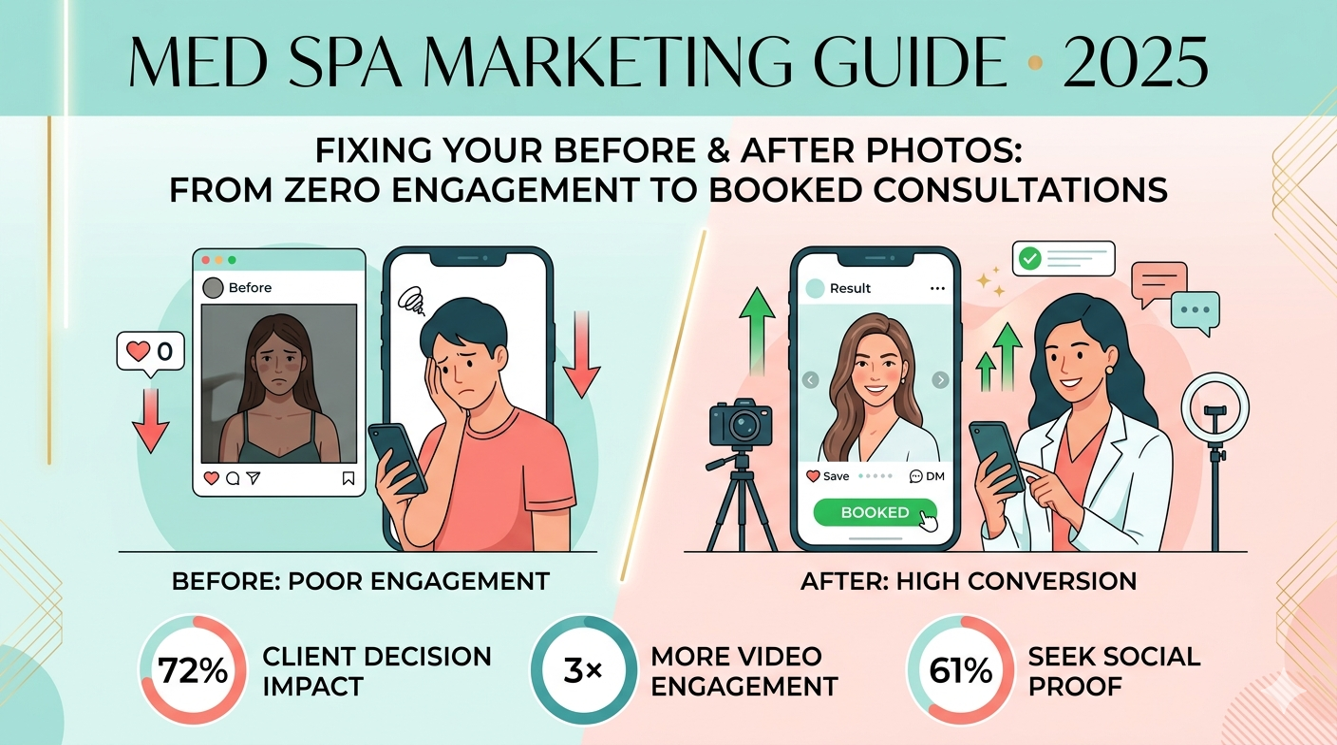
- 72% of med spa clients say before & afters influenced their decision to book
- 3× more engagement on video transformations vs. static before & after images
- 61% of consumers won’t book if they can’t find social proof online
Introduction
The Content That Should Be Your #1 Sales Tool But Isn’t
Picture this: Your injector just delivered a stunning botox result. The client is thrilled. You photograph the before and after, post it to Instagram with the caption “Love this result! ❤️ Book your appointment today, link in bio.” You hit post. And then… nothing. A handful of likes, mostly from your own staff. Zero comments. Zero saves. Zero new inquiries.
Sound familiar? You are not alone and you are not doing something wrong because your results are bad. The results are probably excellent. The problem is almost never the outcome. It is everything around it: the framing, the context, the storytelling, the technical execution, and the strategy.
Before and after photos are theoretically the most powerful marketing asset a medical spa has. They are the closest thing to proof, visual, undeniable evidence that you can deliver on your promise. And yet the majority of med spa Instagram accounts are filled with them, collecting almost no engagement, no comments, no conversions, and no bookings.
This guide will show you exactly why that is happening and, more importantly, how to fix it, transforming your before and after content from ignored filler into a trust-building, appointment-booking engine.
What This Guide Covers
Why before & after content fails · 7 specific failure points with real-world examples · Step-by-step fix strategies · Content ideas beyond static photos · Common mistakes to avoid · A condensed newsletter version at the end you can use immediately
Section 1
Why Your Before & After Photos Are Failing
Before fixing anything, the problem needs an accurate diagnosis. Here are the seven most common reasons med spa before and after content underperforms and every single one is more fixable than you think.
Reason 1: Poor Visual Quality Destroys Credibility Before the Caption Is Even Read
Your results can be genuinely beautiful, but if the photo looks like it was taken in a storage room under fluorescent lighting, viewers will not trust it. In the aesthetics industry, your visuals are your brand. Poor image quality signals poor attention to detail and potential clients make that association with your clinical work, even if it is not fair.
The most common visual quality mistakes include: inconsistent backgrounds (a white wall in one photo, a treatment room curtain in the next), different angles between the before and after shot, mixed lighting temperatures (warm tungsten in the before, cool daylight in the after), low resolution that looks pixelated when expanded, and photos taken on different devices or in different camera modes with no consistency.
Real-World Example
A med spa in Austin invested $400 in a ring light, a dedicated photo backdrop corner, and a phone tripod with an angle-locking arm. Within 60 days of standardizing their photo setup, their before & after posts doubled in saves and they began receiving DMs specifically referencing the quality of their results photos. The investment paid for itself in one new booking.
Reason 2: No Context or Storytelling Makes the Content Forgettable
A photo of a face, then a photo of the same face two weeks later, with the caption “Love this transformation ❤️ Book now!” tells a potential client absolutely nothing useful. And because it tells them nothing, it does nothing.
What treatment was performed? How many units? How long did it take? Was the client nervous beforehand? What were they worried about? What did they say when they saw the result? What is the recovery like? All of these questions are running through the mind of your target audience. If your content does not answer them, it gets scrolled past in under a second.
The most engaging before and after posts are not photo essays, they are micro-stories. They have a beginning (the client’s concern), a middle (the treatment experience), and an end (the result and how the client feels). That structure, even condensed into a 150-word caption, transforms forgettable content into something people read, save, and share with friends who are considering the same treatment.
Reason 3: Compliance Anxiety Is Making Your Captions Legally Cautious but Commercially Useless
HIPAA compliance, platform advertising policies, and FTC guidelines around medical marketing have created a generation of med spa social media captions that say absolutely nothing. “Results may vary.” “Consult a qualified provider.” “For educational purposes only.” These disclaimers are important, but when they make up 60% of your caption, you have traded marketing effectiveness for legal caution to the point of irrelevance.
HIPAA-compliant marketing does not mean sanitized, personality-free marketing. You can tell a client’s story (with signed written consent), describe a treatment experience, and speak directly to the fears and desires of your audience, all within compliance guidelines. The key is obtaining the right consent and understanding what you can and cannot say, rather than defaulting to silence.
HIPAA & Compliance Quick Note
Always obtain written, specific consent before posting any client image, identifying detail, or treatment information. Work with a healthcare compliance consultant to create a photo consent form tailored to your clinic and state. Platform-specific advertising policies for before & after content vary, what is allowed on your website differs significantly from what Meta permits in paid promotions.
Reason 4: The Algorithm Is Actively Working Against Generic Before & After Content
Instagram and TikTok’s algorithms suppress certain types of before and after content in discovery feeds. Meta has explicit policies restricting the promotion of before and after cosmetic imagery in paid ads, and organic reach for static image posts has declined significantly across all platforms and industries.
The algorithm rewards content that drives meaningful interaction: saves, shares, comments, and time-on-screen. A static before and after image with a generic caption achieves none of these. It gets a scroll-past in under a second, which signals to the algorithm that the content is not engaging, which reduces its reach, which means fewer people see it, which means fewer saves and comments, a compounding downward spiral.
The fix is not to stop using before and after content. It is to package it in formats that the algorithm rewards: carousels (which drive significantly more swipe engagement than single images), Reels (which get two to three times more reach than static posts on Instagram), and content that explicitly invites viewers to engage through comments or DMs.
Reason 5: You Are Posting Results Your Ideal Client Does Not Recognize Themselves In
Many med spas post their most dramatic transformations because those feel impressive. But your ideal client, the 38-year-old professional considering her first botox treatment, may not see herself in before and after photos showing extreme volume restoration or highly dramatic results. She is looking for natural. She is looking for “will anyone be able to tell?” She wants to see someone who looks like her, with a concern similar to hers.
The content that converts best is not always the most dramatic. It is the most relatable. Subtle skin texture improvements, natural-looking lip enhancement, refreshed under-eyes, these “no one will know” results speak directly to the largest segment of potential aesthetic clients: those who want enhancement without the appearance of having had anything done.
Reason 6: Your Branding Is Invisible, Anyone Could Have Posted This
Scroll through 20 med spa Instagram accounts. They look almost identical. Same neutral background, same font overlays, same rose-gold palette, same caption format, same emoji usage. When your before and after photos look like everyone else’s, there is zero brand recall. A potential client might save your photo for inspiration and then book with a competitor because she cannot remember which account she saw the result on.
Every piece of before and after content you post should be unmistakably yours, consistent color treatment, a recognizable watermark or logo placement, a signature caption style, and a distinctive visual aesthetic that your audience begins to recognize instinctively. Brand consistency is the compound interest of social media marketing: it builds slowly, then all at once.
Reason 7: No Call-to-Action That Tells Viewers What to Do Next
Most med spa before and after posts end with “Book now, link in bio.” This is the weakest possible call to action. “Link in bio” is a friction-heavy instruction that requires three or four additional steps before a booking happens. It is also so overused that it has become functionally invisible to anyone who has spent more than a week on Instagram.
High-converting before and after content ends with a specific, low-friction call to action. “DM us the word GLOW to receive your personalized treatment quote.” “Save this post and send it to your injector at your next consultation.” “Comment ‘RESULTS’ below and we’ll send you our full before & after gallery.” Each of these creates engagement directly inside the app and moves the viewer one step closer to a booking without requiring them to leave the platform.
Section 2
How to Fix It: Actionable Strategies That Work
Fix 1: Build a Standardized Photo Studio in Your Clinic
You do not need a professional photographer on staff. You need a standardized, repeatable setup that produces consistent results every single time. Here is exactly what to invest in:
Ring light or softbox light: A quality ring light ($80–$150) eliminates harsh shadows and provides even, flattering illumination. Position it at eye level, directly in front of the client.
Neutral backdrop: A matte white or light gray panel or a clean, uncluttered wall section. Paint one corner of your consultation room if needed, this costs less than $30.
Tripod with phone mount: A tripod with a locking arm ensures identical angles between the before and after shot. This single investment eliminates the different-angle problem entirely.
Camera consistency: Designate one device for all clinical photography. The same phone or camera, always using the same camera mode, always at the same distance from the client.
A laminated checklist in the photo area: Same light position, same distance from client, same angle, same focal length. Takes five seconds to check and removes all variability from the process.
Setup Cost vs. Return
A professional photo setup costs $200–$400 as a one-time investment. One new client booking from improved before & after content typically returns $300–$1,500 in first-visit revenue, plus the lifetime value of a loyal patient. The math is straightforward.
Fix 2: Master the Storytelling Caption Framework
Every before and after post should follow this four-part caption structure. It takes 10 minutes to write and dramatically outperforms generic captions in every measurable way:
The Hook (1–2 sentences): Open with the client’s concern, in language your audience recognizes in themselves. “She came to us worried about the hollowness under her eyes that made her look tired, even after a full night’s sleep.”
The Treatment (2–3 sentences): Describe what was done, demystifying the process. Name the treatment, mention the approach, and include a detail that addresses common anxiety, pain level, downtime, session length. “We used 1ml of hyaluronic acid filler placed conservatively under each eye. The appointment took 25 minutes. She rated the discomfort as a 2 out of 10.”
The Result (2–3 sentences): Describe the outcome from the client’s perspective, including an emotional detail. “At her two-week follow-up, she told us she’d stopped reaching for concealer for the first time in years. Her exact words: ‘I look like me again, just more rested.'”
The CTA (1 sentence): One specific, low-friction action. “DM us ‘EYES’ to learn if tear trough filler is right for you, we’ll send you our full information guide.”
This framework works because it mirrors the internal dialogue your potential client is already having. She sees herself in the before. She gets reassured by the treatment description. She gets excited by the result. And the CTA gives her a next step that feels safe and low-commitment, not like clicking a booking link cold.
Fix 3: Transition to Video-First Content
Static before and after photos are increasingly being outperformed by video transformations on every platform. Reels, TikToks, and YouTube Shorts that show the transformation, even a simple swipe-reveal video or a 15-second side-by-side clip, generate two to three times more reach and significantly more saves than equivalent static images.
You do not need a video production team. Here are three video formats any med spa can produce with just a phone:
The Reveal Reel: Film the before photo on screen, then cut to the after. Add trending audio, text overlays with the treatment name and clinic branding, and a caption using the storytelling framework above. Production time: 15 minutes.
The Journey Video: A 30–60 second clip showing the client arriving, a few seconds of in-treatment footage (with consent), and the final result with text narration. This is the highest-converting format for new client acquisition.
The Comparison Carousel: A swipe-format post where slide 1 is the before, slide 2 is the after, and slides 3–5 show detail shots or the client’s written testimonial. Carousels drive significantly more saves than single images and receive multiple impressions per viewer because people swipe back through them.
Fix 4: Integrate Client Testimonials with Visual Results
A before and after photo combined with a genuine client testimonial is exponentially more powerful than either alone. The photo provides visual proof. The testimonial provides emotional proof. Together, they address both the logical and emotional objections a potential client has before booking.
The best way to collect usable testimonials: ask for them immediately at checkout while the client’s enthusiasm is highest. Have a simple digital form on your tablet that includes the question: “In your own words, how do you feel about your results?” Most clients will give you two or three sentences that are genuinely compelling. Even one sentence of authentic client language is worth ten sentences of clinic marketing copy.
Strategic Use of Client Language
The exact words your clients use to describe their results are your most valuable marketing copy. Phrases like “I look like me again” or “My husband didn’t notice I had anything done, he just said I looked amazing” speak to the fears and desires of future clients in a way no professionally written caption can replicate. Collect these phrases. Use them verbatim, with written consent.
Fix 5: Build a Consistent Visual Brand Identity
Consistency is what creates recognition. Recognition is what creates trust. Trust is what creates bookings. Here is how to build a visual brand identity for your before and after content that makes your clinic unmistakable:
Color grading: Apply the same light, consistent filter or color grade to all your clinical photography. Apps like VSCO or Lightroom Mobile allow you to save a custom preset and apply it in one tap to every image.
Watermark placement: Place your clinic name or logo in the same corner of every image, at the same size and opacity. A white or transparent watermark that does not distract from the result is ideal.
Typography consistency: Use the same font for any text overlays you add in Canva or similar tools. Limit yourself to two fonts, one for headings, one for body text and never deviate.
Caption signature: End every caption with the same brand sign-off. Many high-performing med spa accounts end with their branded hashtag, a booking emoji sequence, or their tagline. This creates a recognizable rhythm that loyal followers begin to anticipate.
Posting cadence: Post before and after content on the same day or days each week. Your audience starts to look for it, and the algorithm rewards consistency with sustained reach.
Fix 6: Replace Generic CTAs with Engagement-Driving Alternatives
What most med spas use
- “Book now, link in bio”
- “Results may vary. Consult a provider”
- “Tag a friend who would love this!”
- “Check out our website for more info”
- What converts
- “DM us the word GLOW for your personalized treatment plan”
- “Comment RESULTS and we’ll send our full gallery, 100 photos, filtered by your concern”
- “Save this post, your future self will thank you when you’re ready to book”
- “3 consultation spots open this week. Reply YES and we’ll send you the link”
Fix 7: Leverage User-Generated Content and Social Proof
The most trusted before and after content is content your clients post themselves. User-generated content, a client’s Instagram story showing her result, a TikTok she films leaving your clinic, a Google review with a photo, carries a trust multiplier that no amount of professional photography can replicate, because it is unambiguously authentic.
Actively encourage UGC by creating an environment and a reason for clients to share. Offer a small discount or bonus product to clients who tag your clinic in their results posts. Create a branded hashtag and reference it at checkout. Display a branded mirror or framed corner in your waiting area that clients will want to photograph themselves in front of. Feature client UGC on your stories and feed regularly, always with explicit permission and credit.
Section 3
Content Ideas That Drive Engagement Beyond Static Photos
Before and after photos are one tool in a content ecosystem. The med spas that dominate on social media use multiple content formats that work together to build audience trust, educate potential clients, and create the conditions for booking. Here are twelve content formats that outperform basic before and after posts:
1. The “Meet Your Injector” Series
A short video or carousel introducing the provider who performs your most popular treatments, including their training, their philosophy, what they love about the work, and one fact that surprises clients. Familiarity before the consultation dramatically increases conversion rates, because people book providers they feel they already know.
2. The “Your Questions Answered” Post
Take the most common question you receive about a specific treatment, “Does botox hurt?” “How long does lip filler last?” “Will I look natural?” and answer it in video or carousel format with your before and after as the visual backdrop. These posts get saved at extremely high rates because viewers send them to friends who are considering the same treatment.
3. The 30-Day Check-In Series
Film or photograph a consenting client at the time of treatment, then again at one week, two weeks, and 30 days post-treatment. Post each checkpoint as part of a named series. The sequential format creates anticipation and draws viewers back to your profile multiple times, dramatically improving your algorithm performance.
4. The Behind-the-Scenes Setup Post
Show your treatment room being prepared, your tools being organized, your injection technique from a tasteful distance. These posts humanize your clinic and demystify the experience, which is the number one barrier to first-time bookings. When the process feels familiar and unthreatening, the decision to book becomes easier.
5. The Educational Debunk Post
“5 Things You’ve Been Told About Botox That Aren’t True.” “Why Cheap Filler Might Cost You More in the Long Run.” Educational content that corrects common misconceptions positions your clinic as the authoritative, trustworthy source in your market and it performs exceptionally well with algorithm distribution because it drives comments and shares from people tagging friends who “need to see this.”
6. The Client Testimonial Video
A 30–60 second clip of a real client, with consent, talking about their experience: why they came, what they were nervous about, and how they feel about their result. These are the most powerful conversion assets in aesthetic clinic marketing and simultaneously the most under-utilized. One genuine testimonial video typically outperforms an entire month of static before and after posts in terms of consultation bookings driven.
7. Seasonal Treatment Spotlights
“Why Spring Is the Best Time to Start Laser Treatments.” “Bridal Season Skin Prep: What to Book 6 Months Before the Wedding.” Seasonal content has natural urgency and attracts clients who are actively planning, which means they are much closer to the booking decision than a passive scroller.
8. The Price vs. Value Transparency Post
Clients who are unfamiliar with aesthetic pricing often do not book because they do not know what to expect. A post that breaks down the cost of a common treatment and frames the value, “What you’re actually paying for when you invest in your skin” consistently generates both strong engagement and qualified inquiries from people who were already curious but hesitant to ask.
9. The “Ask Me Anything” Story Session
Use Instagram Stories’ question box to collect audience questions about treatments, pricing, or skin concerns. Answer them in short video clips over 24–48 hours. This format builds genuine familiarity, drives story views, and generates more questions from future sessions as your audience grows more comfortable engaging with you.
10. The Referral Story Post
“She loved her result so much, she brought her sister.” A post telling the story of a client who referred a friend or family member, including both results, taps into the social proof of peer recommendation and consistently performs well because it feels warm, authentic, and relatable rather than promotional.
11. Product Education and Homecare Integration
If you retail medical-grade skincare, before and after content showing skin improvements from a consistent homecare protocol, paired with your clinical treatments, both sells product and demonstrates the compound benefit of being a long-term patient rather than a one-visit client.
12. The “First Treatment” Walkthrough
A post or video narrating exactly what a first-time client can expect from their initial consultation through to their result, including what to say, what questions to ask, and what the day-of experience feels like. This content directly dismantles the anxiety that prevents first-timers from booking, and it is one of the highest-performing content types for new client acquisition at med spas that have tested it.
Section 4
Common Mistakes to Avoid
Mistake 1: Posting Without a Content Strategy
Random, reactive posting is one of the most costly mistakes in med spa marketing. Without a content calendar, most clinics post when they remember, when something looks good, or when staff have a spare moment. The result is inconsistency that prevents both audience building and algorithm momentum. Plan your content four weeks in advance, assign responsibilities, and treat your social media presence as the revenue-generating function it is.
Mistake 2: Using Stock Photos or Manufacturer Before & Afters
This happens more than it should. Using before and after images from device manufacturers, product companies, or stock libraries is not only dishonest, it actively erodes trust when clients recognize them, and many do. Your actual client results, even if less dramatic than manufacturer showcase photos, are infinitely more valuable because they are real. Authenticity is the primary trust currency in aesthetic marketing.
Mistake 3: Ignoring Platform-Specific Best Practices
Content that performs well on Instagram does not automatically perform well on Facebook, TikTok, or your website. Each platform has its own algorithm preferences, content formats, audience demographics, and compliance policies. Instagram rewards Reels and carousels. TikTok rewards authenticity and personality over polish. Facebook rewards educational content with high comment activity. Your website before and afters should be organized by treatment type and optimized for local search. Know where you are posting and optimize for that specific platform rather than cross-posting identical content everywhere.
Mistake 4: Neglecting Comments and DM Responses
A comment on your before and after post is a warm lead. Someone who asks “How long does this last?” or “I’ve been wanting to try this” in your comments is raising their hand. If those comments go unanswered for 24 hours, that person has almost certainly moved on to a competitor who responds faster. Designate someone to monitor and respond to all comments within four hours during business days. This single practice has a direct, measurable impact on bookings for every clinic that implements it consistently.
Mistake 5: Treating Before & After Content as Separate from Your Sales Funnel
Your social media before and after posts should not be stand-alone islands. They should be the entry point of a deliberate client journey: the post drives DMs, the DMs drive consultation bookings, the consultations convert to treatments, the treatments generate reviews and referrals that generate more before and after content. Map this loop consciously and optimize each connection point. When you treat your content as part of a system, every piece you create compounds in value over time.
Mistake 6: Waiting for the Right Moment to Post More
Many med spa owners feel uncomfortable promoting their results, it feels self-promotional, even boastful. This is a confidence issue that costs them bookings every single day. The clients who need what you offer cannot find you if you do not show them what you can do. Posting your results is not bragging. It is serving the people who are actively looking for exactly what you provide. Post more. Post consistently. Post with genuine pride in your clinical work.
Conclusion
Your Before & After Content Can Be Your Best Sales Tool
Your before and after photos are underperforming not because your results are unimpressive, but because the context, storytelling, visual quality, branding, and strategy around them are incomplete. Every reason your content is not working is fixable and most of the fixes require investment of time and attention, not significant money.
The core changes that will move the needle most:
Standardize your photo setup, invest $200–$400 once and benefit from it permanently
Adopt the four-part storytelling caption framework, hook, treatment, result, specific CTA, for every post
Shift to video-first content, Reels and carousels dramatically outperform static images on every platform
Make your brand visually unmistakable, color consistency, watermarks, caption signature style
Replace “link in bio” with engagement-driving CTAs that work inside the app
Build a content calendar and post on a consistent schedule, strategy beats sporadic inspiration every time
Collect and use real client testimonials as the most powerful copy you will ever produce
The med spas that are fully booked, growing their waitlists, and reducing their paid ad spend are not doing something fundamentally different from you. They are doing the same things, just more intentionally, more consistently, and with a deeper understanding of what their ideal client needs to see and hear before she feels confident enough to book.
You have the results. Now give them the stage they deserve.
Your 30-Day Action Plan
Week 1: Set up your dedicated photo corner. Week 2: Rewrite your last 10 captions using the storytelling framework and republish the top 3. Week 3: Film your first transformation Reel and test a DM-keyword CTA. Week 4: Review your engagement metrics and double down on whichever format performed best.
Three Fixes to Implement This Week
Set up a dedicated photo corner: Ring light + neutral backdrop + phone tripod = consistent, professional-looking results for under $300. One-time investment, permanent benefit.
Rewrite your next caption using this framework: (1) Client’s concern in relatable language. (2) What you did plus one reassuring detail about the experience. (3) The result from the client’s emotional perspective. (4) One specific, low-friction CTA.
Try a Reel instead of a static post: Film a simple swipe-reveal or side-by-side video of your next transformation. Add trending audio and a storytelling caption. Compare the engagement to your last three static before and after posts.
This Week’s Metric to Watch
Check the Saves count on your last 10 before & after posts. Saves are the strongest signal of intent, someone who saves a cosmetic result post is significantly more likely to book within 60 days than someone who merely likes it. If your saves are consistently near zero, your content is not giving people a reason to return to it.
That is it for this week, three changes, all implementable before your next post goes live. If you want the full strategy including the complete storytelling framework, video content templates, and a 30-day content calendar, the link is below.