If you searched “med spa near me” right now and your clinic didn’t show up in the top 3 results, you just lost a client. And then another. And another. This happens hundreds of times a day for most med spas, and it costs them between $8,000–$25,000 in lost monthly revenue they never even know about.
You built a beautiful clinic. You invested in the best equipment. Your injectors are skilled, your results are stunning, and your existing clients love you. But none of that matters to the person on their phone right now, typing “botox near me” or “coolsculpting in Irvine”, because they cannot find you.
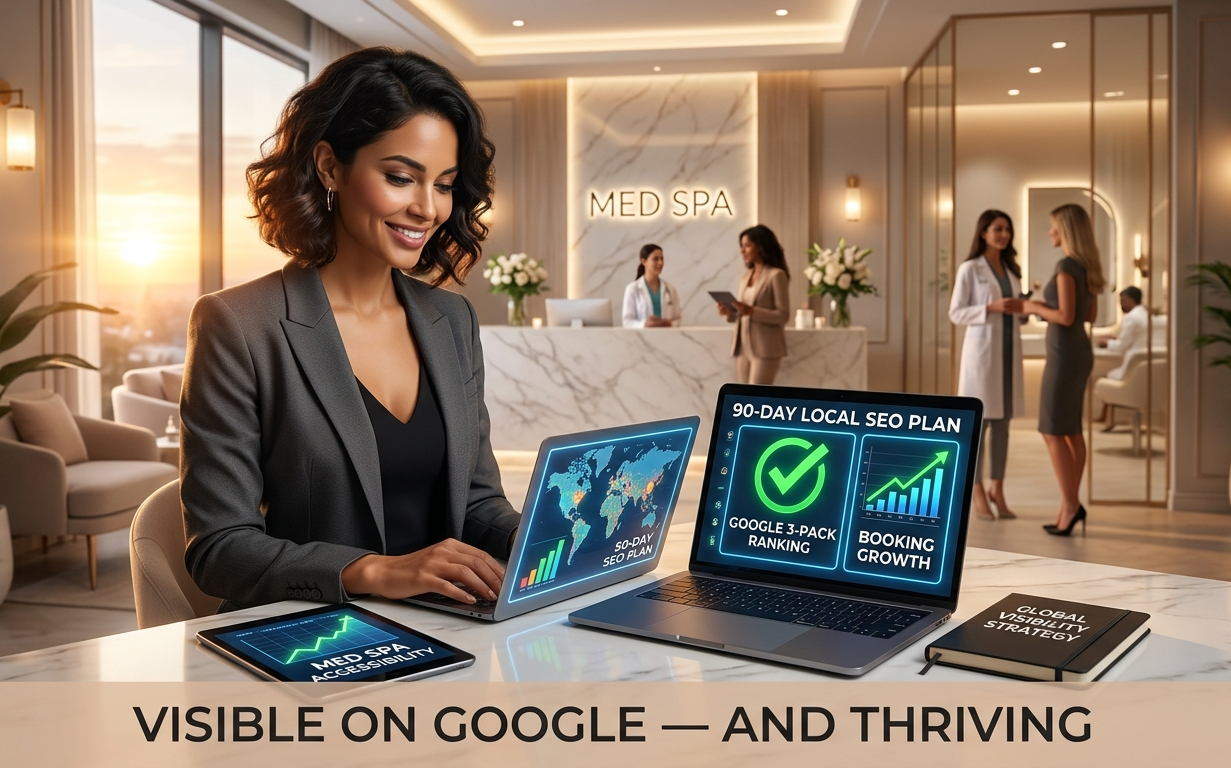
Local SEO for medical spas is one of the most powerful, most misunderstood, and most neglected marketing channels in the aesthetics industry. In this guide, you will get the exact system, not vague advice, but a step-by-step process, that med spa owners have used to go from invisible on Google to fully booked within 90 days.
- 97% of people learn about local businesses online before visiting
- 78% of local mobile searches result in an offline purchase within 24 hours
- 3x more clicks go to the top 3 Google Map results vs. all others combined
- $0 cost per click from organic local SEO vs. $15–$65 per click on Google Ads
The Real Reason Most Med Spas Rank Poorly on Google
Before fixing the problem, let’s diagnose it honestly. Most med spa owners assume they rank poorly because they’re in a “competitive market.” That’s rarely the real issue. The real reasons are almost always operational, things entirely within your control.
Here are the five most common reasons a med spa is invisible on Google, in order of how often they appear:
- Unclaimed or incomplete Google Business Profile
Your Google Business Profile (formerly Google My Business) is the single most important asset in local SEO. If it’s incomplete, missing hours, services, photos, or descriptions, Google deprioritizes it. If it’s unverified, it might not show up at all.
- Zero reviews, or stagnant review count
Google’s local ranking algorithm heavily factors in review quantity, recency, and response rate. A med spa with 12 reviews that are two years old ranks far below a competitor with 45 reviews from the past six months, even if your reviews are slightly better rated.
- Website not optimized for local search terms
Your website might use broad terms like “anti-aging treatments” and “cosmetic procedures” but your potential clients type “botox Irvine” and “laser hair removal near [neighborhood].” If those phrases don’t appear naturally on your website, Google won’t rank you for them.
- Inconsistent NAP data across the internet
NAP stands for Name, Address, Phone. If your clinic’s name is listed as “Glow Med Spa” on Google, “Glow Medical Spa” on Yelp, and “Glow Medspa LLC” on your Facebook, Google’s algorithm treats these as three different businesses. Inconsistency destroys your local authority.
- No local content on the website
Google wants to serve local results. If your website has no content mentioning your city, your neighborhood, or local references, Google has no reason to rank you locally over a national competitor with a bigger domain authority.
Quick self-audit: Do this right now.
Open Google, type “med spa Orange” in an incognito window. Did you appear in the top 3 map results? If not, save this guide, you need every step below.
Step 1: Build an Unbeatable Google Business Profile (Week 1–2)
Your Google Business Profile is not just a listing. It is a mini-website that Google controls, and it is what shows up when someone searches for you by name or by service category in your area. Getting it right is the foundation of everything else.
Complete every single field, no exceptions
Most med spa owners fill out the basics (name, address, phone) and call it done. That is a massive missed opportunity. Google rewards completeness. Here is everything you need to fill in:
- Business name (exactly as it appears on your signage and website)
- Primary category: “Medical Spa” and add all secondary categories that apply (Skin Care Clinic, Laser Hair Removal Service, Facial Spa, etc.)
- Complete address including suite number if applicable
- Local phone number (not a tracking number or 800 number)
- Your exact website URL
- Business hours including special holiday hours
- Booking link (connect directly to your scheduling software)
- Business description, 750 characters, written naturally with your key services and city name
- All services listed individually with descriptions and prices where possible
- Products (if you sell skincare retail)
- Attributes: “Women-owned,” “LGBTQ+ friendly,” “Wheelchair accessible”, check every applicable box
- Health and safety information
- Q&A section pre-populated with your most common client questions
Photos: The #1 most neglected ranking factor
Google’s own data shows that businesses with photos receive 42% more requests for directions and 35% more website clicks. For med spas specifically, photos drive even stronger engagement because your clients are making appearance-based decisions, they want to see your space, your team, and your results.
- The minimum photo set every med spa profile should have:
- Logo image (high resolution, clean background)
- Cover photo (your best treatment room or reception, well lit, inviting)
- Interior photos (reception, treatment rooms, waiting area)
- Exterior photo (helps clients recognize the building)
- Team photos (professional but approachable, clients book people, not just places)
- Treatment photos (in-session, showing the experience)
- Before/after results (client consent required, check your platform policies)
- Product photos if you retail skincare
Pro tip on photo frequency.
Upload 2–3 new photos every week. Google’s algorithm gives a freshness score to listings, and regularly updated profiles rank higher. Set a recurring calendar reminder, even smartphone photos from the clinic floor work, as long as they’re well-lit and show real activity.
Google Posts: The feature 90% of med spas ignore
Inside your Google Business Profile, there is a “Posts” feature. Think of it as a social media feed that appears directly on your Google listing. You can post promotions, events, service spotlights, and updates and they appear in search results.
Google Posts expire every seven days, which creates an opportunity: a med spa that posts weekly signals to Google that the business is active, engaged, and relevant. Post once per week, every week, without exception. Your posts can be as simple as a monthly special, a new treatment announcement, or a tip from your aesthetic team.
Step 2: Build a Review Generation System (Week 2–4)
This is where most med spas completely fall down. They know reviews matter, they occasionally ask happy clients for reviews, and then they wonder why their review count barely moves. The problem is the word “occasionally.” Reviews require a system, not a feeling.
Why reviews matter more than you think
Google’s local ranking algorithm uses three core signals: relevance, distance, and prominence. Reviews are the single biggest controllable variable under “prominence.” A competitor two miles away with 80 reviews will consistently outrank you with 20 reviews, even if your services are superior.
88% of consumers trust online reviews as much as personal recommendations
40+ reviews is the threshold where new clients begin to feel confident booking
3.7x more likely to be chosen when you have 50+ reviews vs. under 10
72 hrs optimal window to request a review after a client’s appointment
The 3-Touch Review Request System
A one-time ask rarely works. Clients intend to leave a review and then get distracted. Your system needs to ask at the right moments, in the right way, without feeling pushy.
In-person ask at checkout (immediate)
Train your front desk team to say: “We’re so glad you loved your results today! If you have a moment this week, we’d be so grateful for a quick Google review — it truly helps our small team more than you know. I’ll send you the link right now.” Hand them a QR card or text the link immediately. Do not say “when you get a chance”, that means never.
Automated follow-up text (24–48 hours post-visit)
Set up an automated SMS through your booking software that sends 24–48 hours after a completed appointment: “Hi [Name], it was so lovely having you in yesterday! If you’re happy with your [treatment name], we’d love a quick Google review, even just a sentence helps so much! [Direct Link]” The direct link should go straight to the review box, not the listing homepage. Every extra click loses 40% of people.
Email reminder (7 days post-visit)
For clients who didn’t review after the first two touches, a gentle email follow-up at seven days captures another 15–20% of reviews. Keep it warm and personal: “Following up on your recent visit, hope you’re loving your results! We’re a small team and Google reviews make a genuine difference for us. Takes less than 60 seconds”
Never do this, it will get your listing penalized.
Do not offer discounts, free services, or any incentive in exchange for reviews. Google explicitly prohibits this, and they have become very good at detecting patterns. A sudden spike of reviews from new accounts, or reviews that mention a discount in the text, are both red flags that can result in your listing being suspended. The only thing you should ever offer is your genuine gratitude.
How to respond to reviews (including the bad ones)
Responding to reviews is not optional, it is a ranking factor. Google’s algorithm registers whether you engage with your reviewers. Respond to every single review within 48 hours, positive or negative.
For positive reviews, keep responses warm but varied. Do not use the same template every time, Google can detect this and it also reads robotically to potential clients who scroll your reviews. Reference something specific: the treatment, the provider by name if mentioned, or a detail from their comment.
For negative reviews, the three-part response formula works every time: acknowledge, empathize, take it offline. “Thank you for sharing this with us, we’re so sorry this wasn’t the experience you deserved. We’d love to make it right. Please call us directly at [number] so we can speak personally.” Never argue, never explain defensively, and never deny. Potential clients read how you handle complaints far more carefully than the complaint itself.
Step 3: Optimize Your Website for Local Search (Week 3–6)
Your Google Business Profile gets clients to your door digitally. Your website is what convinces them to walk through it. These two assets must work together, and both must be optimized for the same local keywords.
The local keyword strategy for med spas
Most med spa website copy is written as if the client already knows where the clinic is. It describes services in clinical or generic terms without tying them to geography. This is a missed opportunity that costs rankings daily.
The keyword structure that works for local med spa SEO:
- botox in Irvine
- med spa Houston
- lip filler near me
- coolsculpting in Florida
- laser hair removal San Deigo
- hydrafacial Orange
- medical spa reviews
- best medspa Athens
- non-surgical facelift Dalton
- PDO thread lift Fort Valley
Each major service you offer should have its own dedicated page on your website, not a section within a page, but a full standalone page. A page titled “Botox in Irvine, Natural Results at Vivid aesthetics” will consistently outrank a single “Services” page that mentions botox in one paragraph.
The anatomy of a high-ranking service page
Every service page on your med spa website needs these elements to rank and convert:
- Page title including service name + city (example: “Botox Treatments in Austin, TX | Glow Med Spa”)
- H1 heading with service + city (example: “Natural-Looking Botox in Austin”)
- Opening paragraph with primary keyword used naturally in the first 100 words
- What the treatment is, in plain language clients actually use
- What results to expect and how long they last
- Your specific approach or differentiator (what makes your clinic different)
- Pricing information or range (this captures “how much does botox cost in Tampa” searches)
- FAQs section (these often appear in Google’s “People Also Ask” boxes)
- Before/after gallery specific to that treatment
- Provider bio for who performs the treatment
- Clear booking CTA above the fold and at the bottom of the page
- Schema markup (structured data) for local business and medical procedure
What most med spas do
One “Services” page listing Botox, Fillers, Laser, and HydraFacial in bullet points. No local keywords. No pricing. No FAQs. One generic “Book Now” button at the bottom.
What high-ranking med spas do
8–15 individual service pages, each 800–1,200 words, targeting specific local keywords. Pricing ranges included. FAQs. Provider profile. Before/after gallery. Multiple booking touchpoints.
Website speed and mobile optimization
Google uses mobile-first indexing, meaning it ranks your website based on how it performs on mobile, not desktop. For med spas, this is critical because the majority of “near me” searches happen on smartphones. A website that loads slowly or looks broken on mobile is being actively penalized in local rankings.
Test your site right now: go to PageSpeed Insights (Google’s free tool) and enter your URL. A score below 70 on mobile is costing you rankings. The most common culprits are oversized images, outdated WordPress themes, and third-party booking widgets that load slowly.
Step 4: Build Local Citations and Backlinks (Week 4–8)
Citations are mentions of your med spa’s name, address, and phone number across the internet. Backlinks are links from other websites to yours. Both are signals that tell Google your business is legitimate, established, and authoritative in your local area.
The essential citation directories for med spas
Your NAP information must be listed consistently on these platforms, and every listing must match your Google Business Profile exactly, same spelling, same abbreviations, same suite number format:
- Yelp (very high weight for local SEO)
- RealSelf (dominant in aesthetics, critical for med spas)
- Healthgrades
- Zocdoc (if you have medical providers)
- WebMD directory
- Facebook Business Page
- Apple Maps
- Bing Places
- Yellow Pages
- Better Business Bureau
- Chamber of Commerce directory for your city
- Local news websites that have business directories
Local backlink strategy for med spas
Backlinks from locally relevant websites are gold for local SEO. These are harder to get than citations but far more powerful. Three strategies that work specifically for med spas:
Local press and features
Reach out to your city’s lifestyle magazine, local news websites, and “best of” publications. Offer an expert quote on aesthetic trends, a behind-the-scenes feature, or an exclusive promotion for their readers. A single feature on a local news site can provide a powerful backlink and often drives direct bookings as well.
Complementary business partnerships
Partner with local wedding planners, bridal boutiques, gyms, yoga studios, and luxury hotels. Create a mutual referral arrangement and ask that they mention and link to your clinic on their website’s “partners” or “resources” page. These are some of the highest-converting backlinks because the audience is already primed for your services.
Local blog and influencer collaborations
Every city has local lifestyle bloggers, mom bloggers, and beauty influencers with established websites. Offer a complimentary treatment in exchange for an honest blog post review with a link to your website. Even micro-influencers with 3,000–10,000 followers who run an active blog can provide highly valuable local backlinks.
Step 5: Create Local Content That Attracts Your Ideal Client (Week 6–12)
Content marketing for med spas is not about writing blog posts for the sake of having a blog. It is a deliberate strategy to answer the questions your potential clients are actively searching for and then positioning your clinic as the local authority on those answers.
“The med spa that answers the most questions wins the most clients. When someone types a question into Google and your website gives them the best answer, they arrive at your booking page already trusting you, before they’ve ever spoken to anyone on your team.”
The content types that drive local med spa bookings
These are the four content categories that generate the highest conversion rates for med spa websites, in order of effectiveness:
1. Local comparison content
Articles like “Best Med Spas in Orange: What to Look For in 2025” or “Botox vs. Dysport in Plywood: Which Is Right for You?” These rank for high-intent local searches and attract people who are in active buying mode, researching before they book.
2. Cost and pricing content
“How Much Does Botox Cost in Athens?” and “What Does a HydraFacial Cost at a Medical Spa?” are some of the most-searched questions in the aesthetics space. Most med spas avoid publishing pricing because they fear competitors. This is a mistake. The clients who search for pricing information are ready to book, they just want to know if it fits their budget.
3. Educational treatment guides
First-time clients are often anxious and have many questions. Articles like “Your First Botox Appointment: What to Expect, What to Ask, and What to Do After” build trust before the consultation happens and dramatically improve conversion rates from inquiries to booked appointments.
4. Seasonal and timely content
“The Best Skin Treatments to Book Before Summer in Atlanta” or “Why Fall Is the Perfect Time to Start Laser Treatments” creates urgency tied to real seasonal patterns in client behavior. These articles are relatively easy to write and reliably generate spikes in appointment requests.
Your 90-Day Local SEO Action Plan
Here is how to sequence everything above into a realistic 90-day implementation:
Days 1–14: Fix your Google Business Profile completely
Audit every field. Update your description with local keywords. Upload 20+ photos. Add all services with descriptions. Set up the booking link. Pre-populate the Q&A section. Start posting weekly updates.
Days 7–21: Implement your review generation system
Create your QR review cards. Set up automated follow-up texts in your booking software. Brief your front desk team and role-play the ask. Set a goal: 10 new reviews in the first month.
Days 14–45: Optimize your website for local search
Audit your current service pages. Create individual service pages for your top 5 treatments. Add local keywords naturally. Test mobile speed. Ensure NAP information matches your Google Business Profile exactly on every page.
Days 21–60: Build your citation network
Create or claim profiles on every directory in the list above. Verify that your NAP is identical across all platforms. This is tedious but one-time work with lasting results.
Days 45–90: Launch your local content strategy
Publish two blog posts per month targeting local search terms. Write one pricing guide for your highest-demand service. Reach out to two local publications or bloggers for feature opportunities.
Day 90: Measure and iterate
Check your Google Business Profile Insights for views, search queries, and direction requests. Check your Google Search Console for organic keyword rankings. If you followed every step, you will see measurable movement. Most med spas that implement this full system see first-page local rankings within 60–90 days on at least 3–5 of their target keywords.
How Much Is Ranking #1 Worth to Your Med Spa?
Let’s put this in concrete financial terms, because local SEO is often dismissed as “too slow” or “too uncertain” compared to paid advertising. This comparison tells a different story.
$45 average cost per click for “botox near me” on Google Ads
2,400 monthly searches for “med spa Irvine” in most metro areas
27% click-through rate for #1 Google Maps result
$0 ongoing cost per click once you rank organically
If your city sees 2,000 searches per month for your target keywords and the top organic result captures 27% of those clicks, that’s 540 visitors per month from search alone. At a conservative 3% booking rate and a $350 average first visit value, that’s $5,670 in revenue per month from SEO, without spending a dollar on ads.
Over 12 months, that’s $68,000 in revenue from traffic you own. Compare that to $45 per click on Google Ads for the same volume: you’d spend $24,300 per month just to match it. Local SEO is not slow, it is the highest-ROI marketing investment a med spa can make over any 6–12 month horizon.
When to Get Expert Help
Everything in this guide is implementable by a motivated med spa owner or a capable office manager. But there is a real cost to doing it partially or inconsistently, an incomplete local SEO strategy produces almost no results, while a complete one produces compounding results month after month.
These are the signals that it’s time to bring in a specialist:
- You’ve been in business 12+ months and still don’t appear in the local 3-pack
- A competitor opened after you and already outranks you
- You’ve done “some SEO” but can’t point to specific keywords you rank for
- Your team doesn’t have the bandwidth to consistently execute content and reviews
- You want to expand to a second location and need to rank in a new city
Get a Free Local SEO Audit for Your Med Spa
Find out exactly where you rank, what you’re missing, and what it will take to reach the top 3 in your city, with a personalized audit tailored to your clinic.
Final Thought: Local SEO Is a Long-Term Asset, Not a Quick Fix
The med spa owners who win at local SEO are not the ones who look for shortcuts. They are the ones who understand that every Google review earned, every local keyword ranking achieved, and every new service page published is a permanent asset, something that continues working for their business every day, compounding in value over time.
Your competitors are not doing all of this. That is your opportunity.
Start with your Google Business Profile today. Get your first 10 reviews this month. Build your service pages over the next six weeks. In 90 days, search your own keywords and this time, you’ll be there.
Save this guide for your team.
Share this with your marketing manager, office manager, or the team member responsible for your online presence. Walk through it section by section. The clinics that implement local SEO consistently are the clinics that stop worrying about where their next client is coming from.