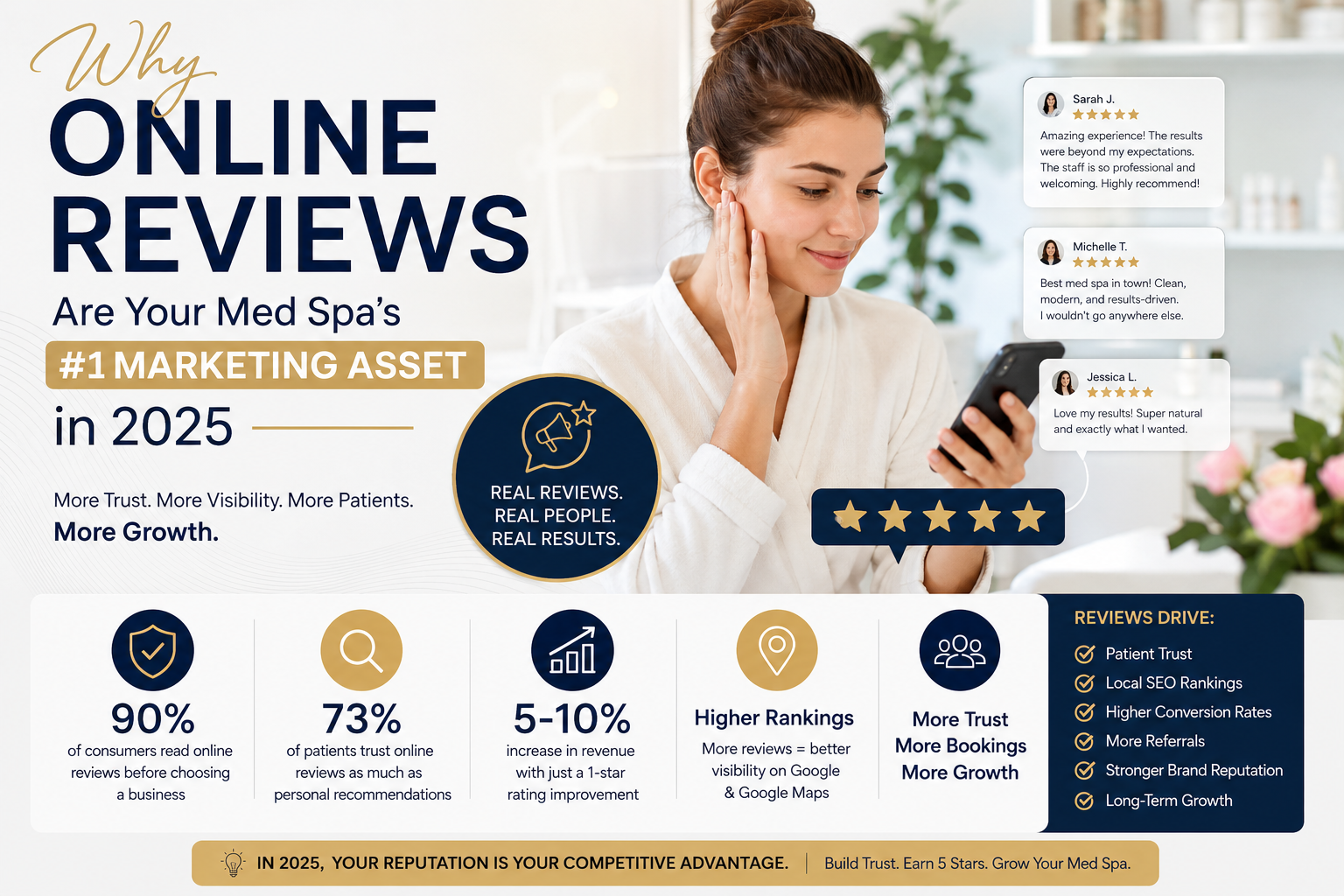
In 2025, online reviews are no longer just a reputation signal for med spas. They are one of the most important growth assets in the entire patient acquisition system because they influence trust, local visibility, conversion rates, and revenue at the exact moment a prospective patient is deciding whether your clinic is credible enough to book. In a market where U.S. medical spas are competing harder than ever for high-intent local searches, reviews often determine who gets the call, who gets the consultation, and who gets the treatment.
For med spa owners, cosmetic injectors, dermatology clinics, and aesthetic practice managers, the message is simple: if you are not treating online reviews as a core part of your medical spa marketing strategy, you are leaving revenue on the table. The clinics that win in 2025 are not just the ones with the best treatments; they are the ones that have built the strongest evidence of trust.
Why 2025 Is Different for Med Spas
The med spa industry has matured into a highly competitive, high-trust category. Patients are no longer impressed by polished branding alone, and they are not making decisions based on ads in isolation. They are cross-checking Google reviews, comparing before-and-after content, reading review language, scanning social proof, and looking for signs that a clinic is safe, skilled, responsive, and consistent.
This shift matters because med spa services are not impulse purchases in the same way as low-cost beauty products. They are personal, visible, and emotionally loaded decisions. A patient is not just buying Botox, filler, laser treatments, or skin rejuvenation. They are buying confidence, judgment, and reduced risk. That means trust has become the new currency in med spa marketing, and reviews are the fastest way to build it at scale.
Trust Is the New Currency
Trust has always mattered in healthcare-adjacent businesses, but in 2025 it is now directly tied to digital performance. A practice can have a great location, strong paid ads, and a beautiful website, yet still lose business if the review profile looks thin, outdated, inconsistent, or ignored. Patients interpret reviews as real-world proof that your brand delivers on its promise.
This is especially true in the U.S. market, where consumers are accustomed to comparing providers before booking. They want reassurance that others have had good experiences, that the team communicates well, that results look natural, and that the clinic handles concerns professionally. In other words, they want evidence. Online reviews provide that evidence in a format people trust almost instinctively.
Consumer Trust Has Evolved
The way patients evaluate med spas has changed dramatically over the last few years. In the past, a strong ad campaign or a beautiful website could carry a lot of weight. Today, the journey is much more layered. A prospective patient may see an Instagram ad, visit the website, check Google reviews, browse real patient photos, ask a friend, and then return later after seeing more proof.
That behavior creates a new standard for med spa digital marketing. People are not looking for perfect marketing; they are looking for believable marketing. They want to see signals of real patients, real results, real professionalism, and real consistency. Reviews satisfy that need better than almost any other channel because they come from peers, not from the brand itself.
Why Reviews Beat Advertising
Advertising can create attention, but it rarely creates trust on its own. This is one of the most important truths in cosmetic clinic marketing. A well-run ad campaign may bring traffic, but reviews are often what convert that traffic into appointments. Patients may click an ad because the offer is attractive, but they book because the clinic feels safe.
That distinction matters.
Paid media is rented attention.
Reviews are owned trust.
Ads can be turned off tomorrow, and the leads disappear.
Reviews, on the other hand, keep working in the background, influencing search visibility, click-through rates, consultation bookings, and treatment decisions long after they were written.
For many U.S. med spas, this is the difference between a fragile marketing system and a durable one. A business dependent only on ads has to keep paying to stay visible. A business with strong online reviews builds a compounding asset that improves over time. That is why med spa reputation management is not a side task; it is a growth strategy.
The Psychology of Social Proof
Humans are wired to look to others when making uncertain decisions. This is especially true when the decision involves appearance, money, and health-related concerns. Patients want to know that others have already taken the same step and been satisfied. That is social proof in action.
In aesthetic clinic marketing, social proof works because it reduces perceived risk. If someone is considering a lip filler, laser resurfacing, or a skin tightening procedure, they are often weighing not only the potential benefit but also the possible regret. Reviews help tip that balance by showing that real patients achieved desirable outcomes and felt cared for during the process.
There is also an emotional component. People trust people like themselves. A review that says, “I was nervous, but the provider explained everything clearly and my results looked natural,” often does more than a polished brand message because it mirrors the inner monologue of the prospective patient. That kind of emotional resonance is one reason med spa reviews are so powerful.
Why Med Spas Depend on Reviews More
Not every business depends on reviews equally. Med spas, Botox clinics, cosmetic injectors, and wellness clinics are especially review-sensitive because the service is both personal and visual. Patients are judging not only whether the treatment works, but whether the provider understands facial balance, aesthetic judgment, comfort, and safety.
In other words, your reviews are doing multiple jobs at once. They validate skill, bedside manner, treatment experience, and outcomes. They also help answer questions that a website cannot answer fully, such as: Is this clinic consistent? Do patients feel heard? Are the results subtle or overdone? Does the staff seem professional? Are concerns handled respectfully?
That is why online reviews for med spas carry more weight than they do for many other service businesses. They are part credibility signal, part conversion tool, and part brand filter. The stronger your review profile, the more likely you are to attract the right patients and repel the wrong ones.
Google Reviews and Local SEO
Google reviews play a major role in local SEO for med spas. When someone searches for terms like “med spa near me,” “Botox clinic in [city],” or “aesthetic clinic near me,” Google’s local results often determine who gets seen first. In that environment, reviews influence both visibility and click behavior.
Google looks at multiple signals when ranking local businesses, including relevance, distance, and prominence. Reviews contribute heavily to prominence because they show that real people are engaging with the business. A clinic with frequent, recent, high-quality reviews is sending a strong message that it is active, trusted, and serving patients consistently.
Review quantity matters, but so does review quality and velocity. A med spa that receives steady reviews every month appears more current than one that collected 80 reviews three years ago and none recently. Recency builds confidence. It tells both Google and the patient that the practice is active and relevant right now.
E-E-A-T and Review Signals
E-E-A-T, experience, expertise, authoritativeness, and trustworthiness, matters deeply in medical and aesthetic categories. While Google does not rank a local business on E-E-A-T in the exact same way it evaluates articles, the same trust logic influences the broader perception of your brand. Reviews support that perception by providing proof from patients who have experienced your services directly.
For med spa SEO, this means review content itself can become a ranking asset. When patients naturally mention treatments, staff names, city names, and specific outcomes in their reviews, they help reinforce topical relevance. That supports aesthetic clinic SEO by giving search engines more context about what your business does and how it is perceived.
This is one reason the best med spa marketing strategies always connect review generation with local SEO for med spas. The review is not only a reputation item; it is also a search signal that can strengthen your visibility in Google Maps, organic local results, and branded search.
Local Search Visibility
Local search is where the highest-intent med spa leads often come from. These are people who are already looking for a provider, already comparing options, and already close to booking. Reviews are a major factor in whether your business gets selected from that shortlist.
The practical effect is straightforward. A practice with better reviews is more likely to earn clicks from the map pack, more likely to get calls from searchers, and more likely to convert website visits into appointments. When the review profile is strong, it creates a halo effect across the rest of the funnel.
This halo effect is especially important in competitive U.S. metro markets where multiple med spas may be within a few miles of one another. In those markets, a difference of just a few tenths of a star or a few dozen recent reviews can influence patient choice. That is why Google reviews for med spas are not cosmetic; they are commercial.
Conversion Rates Rise with Reviews
Conversion rate is where online reviews become especially visible as a business asset. A prospective patient who sees positive reviews is more likely to fill out a form, request a consultation, respond to SMS outreach, or call the office. Reviews reduce hesitation, and reduced hesitation increases action.
Think about what a patient is really asking before booking. They are asking whether the clinic is skilled, whether the results will look natural, whether the team is friendly, whether the experience will be worth the money, and whether they can trust the provider with their face. Reviews answer those questions more convincingly than almost any other content format.
This is why med spa lead generation improves when review strategy improves. It is not just about getting more leads. It is about making the same traffic work harder. In a well-built funnel, reviews act as a trust bridge between interest and conversion.
Revenue Growth Follows Trust
Positive reviews do not just improve sentiment; they change financial outcomes. Strong review profiles often lead to more booked consultations, higher treatment acceptance, more referrals, and greater repeat business. Over time, that creates real revenue growth.
The reason is simple: the cost of winning a patient is far higher than the cost of keeping one satisfied. Reviews help you do both. They attract better-fit new patients and reassure existing patients that they made the right decision. That increases both acquisition and retention, two of the most important drivers of med spa growth strategy.
Reviews also influence the types of patients you attract. A strong reputation tends to bring in patients who are more aligned with your brand, more likely to trust recommendations, and more willing to invest in premium services. That improves average ticket size and lifetime value, which are critical metrics in medical spa marketing.
The Patient Journey Is Review-Driven
The modern patient journey is no longer linear. Someone may discover your clinic through Google, revisit via Instagram, compare you on Yelp, ask a friend for an opinion, then come back through branded search days later. At several points in that journey, reviews act as the deciding factor.
That means reviews influence every stage of the funnel. At the discovery stage, they improve visibility and click-through. At the evaluation stage, they build confidence. At the booking stage, they reduce uncertainty. After treatment, they reinforce satisfaction and encourage referrals.
This is one of the reasons med spa customer acquisition should never rely on a single channel. Your paid ads, SEO, social, email, and website all matter, but reviews thread through all of them. They are the connective tissue that makes the entire system more believable.
Reviews Build Brand Authority
Brand authority is what makes a med spa feel established rather than merely active. It is the sense that your practice has depth, consistency, and credibility. Reviews are one of the clearest ways to build that authority because they show public evidence of experience over time.
A clinic with 400 authentic reviews, thoughtful responses, strong ratings, and consistent patient stories will almost always appear more authoritative than a clinic with no visible feedback, even if the latter has a prettier website. People trust crowds because crowds imply validation. When that validation is documented in reviews, it strengthens the brand.
This is particularly important in med spa branding strategies. Brand authority is not created only through logos, colors, and tone of voice. It is also created through the accumulation of proof. Reviews give your brand a lived reputation, not just a designed identity.
Negative Reviews Are Not the Enemy
Many clinics treat negative reviews as a disaster. In reality, a thoughtful response strategy can turn them into a credibility signal. A perfect 5.0 rating with no critical feedback can sometimes look less believable than a strong rating with a few reasonable critiques and professional responses.
Negative reviews can also reveal operational issues. Maybe patients are confused about aftercare. Maybe the front desk feels rushed. Maybe expectations are not being set clearly enough. These are business problems disguised as reputation problems. When you fix them, both the experience and the reviews improve.
The goal is not to eliminate every negative review. The goal is to show that your practice handles concerns with maturity, empathy, and professionalism. That is a powerful trust signal for future patients.
How to Handle Negative Reviews
Professional review management starts with speed, empathy, and discipline. When a negative review appears, the worst possible response is defensiveness. That tells future readers that the practice may not handle pressure well. A better response is calm, specific, and solution-oriented.
The core structure should be simple. Thank the reviewer for the feedback, acknowledge their concern without arguing, offer to continue the conversation offline, and keep the tone respectful. Never reveal private patient information publicly, and never engage in a back-and-forth argument online.
This is a crucial part of online reputation management for med spas. The response itself is not only for the reviewer; it is for everyone else who will read it later. A smart response can reduce fear, demonstrate accountability, and even recover trust in the eyes of a potential patient who has never met you.
Reputation Recovery Strategy
If a clinic receives a string of poor reviews or a damaging complaint, the solution is not panic. It is process. Reputation recovery should begin with an internal audit. Review the patient experience from intake to follow-up and identify where expectations, communication, or service delivery may be breaking down.
Once the operational issue is understood, the clinic should improve the process and then rebuild public trust through more consistent positive reviews. This is where review velocity matters. If you generate a healthy stream of recent positive experiences, the impact of an older negative review becomes less significant over time.
You also want to make sure your team is aligned. A strong reputation recovery strategy is not just a marketing project. It is an operational one. Every team member contributes to the patient experience, which means every team member also contributes to the review outcome.
A Step-by-Step Review System
The most successful med spas do not “hope” for reviews. They install a system. Review generation should be a repeatable workflow, not an occasional request. That means every stage of the patient journey should support the process.
Start by identifying the best moments to ask. These are usually moments of peak satisfaction, such as after a visible result, after a follow-up visit, or after a patient expresses appreciation for the experience. At that point, the request feels natural rather than forced.
Then create a simple process. The front desk, clinical team, or follow-up automation should invite the patient to share feedback through a direct link. That link should route to the correct platform and make it as easy as possible to leave a review. The fewer steps, the better the conversion.
Ethical Review Generation
Ethical review collection is essential. The goal is not to manipulate patients or incentivize fake praise. It is to make it easy for satisfied patients to share their real experiences. That distinction matters both legally and strategically.
The best ethical approach is to ask consistently, politely, and without pressure. You can let patients know that their feedback helps others make informed decisions and helps the clinic continue improving. That framing is honest and effective.
Do not gate reviews by asking only the happiest patients to post publicly while sending unhappy patients to private channels exclusively. Do not offer discounts in exchange for positive reviews. And do not script the wording. Genuine reviews are far more credible, and credibility is the entire point.
Best Timing for Review Requests
Timing is one of the most underrated factors in getting better reviews. If you ask too early, the patient may not yet have experienced the result. If you ask too late, the enthusiasm has faded. The best time is usually when the patient has had enough time to see value but still remembers the experience clearly.
For injectables, that might be after the initial settling period or at a follow-up visit. For skin treatments, it may be when the patient starts noticing visible improvement. For other services, it may be immediately after a positive appointment or once the patient has expressed satisfaction during conversation.
Good timing creates better quality feedback. It also increases the likelihood that the review will include useful detail about the experience, staff, results, and comfort level, which makes the review more persuasive to future patients.
Automation Makes Reviews Scalable
A manual review process is hard to sustain at scale. That is why review automation systems are so valuable in modern med spa digital marketing. Automation makes the process consistent, reduces staff burden, and ensures no opportunities are missed.
An effective system can be triggered after appointments, follow-ups, or treatment milestones. It may send a text message, an email, or both. The message should be short, respectful, and mobile-friendly. It should include a direct link to the preferred review platform and avoid unnecessary friction.
Automation also helps with follow-up. If a patient does not respond to the first request, a gentle reminder can be sent later. The key is to remain courteous and avoid over-messaging. The process should feel like a service, not a demand.
SMS and Email Campaigns
SMS is often the highest-converting channel for review requests because it is immediate and easy to act on. Email still matters, especially for more detailed follow-up and for patients who prefer a more formal touch. The strongest systems use both.
A good SMS campaign is concise. It should thank the patient, reference the recent visit, and include a direct review link. Email can be slightly more detailed and may include a brief note about how feedback helps the practice improve patient care and guide future patients.
For cosmetic clinic marketing, the tone matters as much as the channel. The request should feel personal, not automated. A message from a real team member or a branded system that still sounds human will usually outperform a generic mass request.
Video Testimonials and UGC
Text reviews are powerful, but video testimonials and user-generated content can create an even deeper level of trust. In 2025, video is one of the most effective formats for med spa social proof because it captures emotion, expression, and authenticity.
A patient speaking on camera about their experience, even for 30 to 60 seconds, can be far more persuasive than a written review alone. The viewer hears the tone, sees the confidence, and gets a better sense of the real outcome. That helps overcome skepticism.
User-generated content also works well on social platforms. When patients voluntarily share their experience, tag the clinic, or post about their results, they create authentic proof that reinforces the brand. This kind of content is particularly useful in aesthetic business growth because it blends marketing with real-world validation.
Before-and-After Content Strategy
Before-and-after content is one of the strongest assets in med spa marketing when used responsibly. It gives patients a visual framework for what is possible and helps them understand the style of results your practice delivers. But it should always be accurate, consent-based, and professionally presented.
The best before-and-after strategy combines visuals with narrative. A photo alone is helpful, but a photo plus a review excerpt or patient story is even better because it explains the transformation in human terms. That creates stronger emotional resonance and better conversion performance.
For Google and SEO, before-and-after content can also support topical relevance when paired with treatment-specific pages. For example, a Botox clinic marketing page or filler service page can include patient stories, short testimonials, and visual proof to strengthen both trust and engagement.
Best Platforms for Reviews
Not all review platforms serve the same purpose, but a smart med spa should maintain a presence across several of them. Google Business Profile is the most important because of its direct relationship to local search visibility and Google Maps rankings. It is the primary review destination for most clinics.
Yelp still matters in many U.S. markets because some patients use it as a secondary validation source. RealSelf is especially important for cosmetic and aesthetic practices because it attracts high-intent users researching elective procedures. Facebook can support social proof and local credibility, especially when patients already know the brand through community engagement.
Trustpilot is less central for many med spas than Google or RealSelf, but it can still add credibility in some branded ecosystems. The larger point is that multi-platform review presence makes a practice feel broader, more established, and more trustworthy than one that only exists in a single channel.
Google Business Profile Comes First
If a med spa can only prioritize one review platform, it should be Google Business Profile. This is where patients often make their first impression of the practice, and it is where local search performance is most directly affected. The star rating, review volume, recency, and response behavior all influence perception.
A strong Google profile supports both discovery and conversion. It can improve your appearance in map results, increase click-through rate, and reduce hesitation once a patient lands on your site. For local SEO for med spas, this is the foundational platform.
It is also the platform most directly tied to action. Patients often call, request directions, or visit the website straight from the listing. That means your Google reviews are not just branding; they are part of the lead flow.
How Reviews Reduce Ad Costs
Paid advertising becomes more efficient when trust is stronger. That is because ads do not work in a vacuum. The more credible your brand looks, the more likely people are to click, stay, and convert. Reviews improve all three of those behaviors.
On Google Ads, stronger trust signals often improve landing page performance, which can lower cost per acquisition over time. On Facebook and Instagram, reviews help make cold traffic warmer. When someone sees an ad and then checks your review profile, the presence of strong feedback makes the ad more believable.
This is why med spa lead generation should always include reputation as a performance lever. Better reviews mean better conversion efficiency, and better conversion efficiency means lower paid media waste. Over time, that has a major impact on med spa customer acquisition costs.
Reviews Improve Ad Performance
There is also a softer but equally important effect: reviews improve ad effectiveness because they reduce skepticism. A patient who sees social proof is more likely to trust the message in the ad. That matters because many aesthetic services are emotionally sensitive and involve real perceived risk.
Think of reviews as support content for your ad ecosystem. The ad creates attention, but the review profile validates the claim behind the ad. That combination is significantly more persuasive than either one alone.
This is one reason the best med spa marketing strategies integrate paid media and reputation management rather than treating them as separate functions. The strongest campaigns use both. One creates reach; the other creates belief.
AI and Search in 2025
Artificial intelligence has changed search behavior and reputation analysis in important ways. Search engines are increasingly capable of understanding context, sentiment, and topical relevance in more nuanced ways. That means review quality and review language matter more than ever.
AI tools also help patients compare options faster. People can summarize, scan, and analyze large amounts of information very quickly. If your review profile is weak or inconsistent, that becomes more visible in a world where comparison is easier. If your reviews are strong, AI-driven summarization can work in your favor by reinforcing your brand’s reputation.
For med spa reputation management, this creates both opportunity and risk. It means clinics should monitor sentiment closely, maintain accurate brand information, and ensure that the customer experience is aligned with the claims being made. In a more algorithmic environment, authenticity becomes even more valuable.
Future Trends in Med Spa Marketing
The next phase of med spa digital marketing will be more trust-centric, more personalized, and more evidence-driven. Reviews will continue to act as a foundation, but they will increasingly work alongside video proof, patient education, and transparent outcome storytelling.
We are likely to see more emphasis on local credibility signals, more scrutiny of paid claims, and more use of review content in omnichannel campaigns. The clinics that adapt best will be the ones that treat reputation as an operating system rather than a marketing afterthought.
That means future growth will depend on a balance of search visibility, patient experience, automation, and brand authenticity. The med spas that master all four will be the ones that stand out in a crowded market.
Common Mistakes to Avoid
Many clinics undermine their own review strategy by making avoidable mistakes. One of the biggest is failing to ask consistently. If the team only requests reviews occasionally, the profile never gains momentum. Another is asking at the wrong time, before the patient has had a meaningful experience to evaluate.
Another mistake is over-relying on one platform while ignoring the rest. A strong Google profile matters most, but a diversified review footprint creates broader trust. Clinics also often neglect response management, leaving positive reviews unanswered and negative reviews unresolved.
Finally, some practices separate marketing from operations too sharply. Review performance is usually a direct reflection of the patient experience. If reviews are weak, there is often a deeper issue in communication, expectation-setting, or service consistency. That makes review strategy both a marketing and a management issue.
Advanced Reputation Growth Framework
A high-performing med spa can think about reputation in four layers: acquisition, experience, amplification, and optimization. Acquisition means bringing in patients who are a good fit. Experience means delivering consistently excellent care. Amplification means collecting and showcasing proof. Optimization means using feedback to improve.
This framework is powerful because it aligns reputation with business performance. You are not just collecting stars. You are building a system where patient satisfaction fuels marketing, and marketing attracts more of the right patients.
For aesthetic clinic SEO and cosmetic clinic marketing, this is especially effective because the strongest reviews usually come from the patients most aligned with your brand promise. Those reviews then attract more similar patients, creating a positive cycle of trust and growth.
Building a Five-Star Experience
A five-star review strategy begins long before the request is made. It starts with the patient experience itself. Are calls answered quickly? Are expectations explained clearly? Is pricing transparent? Does the team follow up after treatment? Are patients made to feel safe and respected?
When the experience is strong, review generation becomes easier. Patients are naturally more inclined to share their satisfaction when they feel seen and cared for. That means reputation management is not just about asking well; it is about delivering well.
This is the deeper lesson of med spa branding strategies. The brand is not only what you say about yourself. It is what patients say about you after they have lived the experience. Reviews are the public version of that brand truth.
Review Response Templates
A good response strategy should be ready in advance. Positive reviews deserve appreciation and personalization. A response should thank the patient, acknowledge the feedback, and reinforce the relationship in a warm but professional tone.
For neutral or mixed reviews, the response should show gratitude, clarify any misunderstandings gently, and offer a path for continued conversation. For negative reviews, the response should remain calm, respectful, and solution-oriented. The goal is not to win an argument. It is to preserve trust.
Templates help maintain consistency, but they should never sound copy-pasted. Small touches of personalization matter. They show that the practice is attentive and human, which is exactly what patients want to see.
Review Systems Should Be Automated
The best med spa growth strategies are scalable, and that applies to reviews too. Manual efforts work for a while, but automation is what keeps the process consistent as the practice grows. The system should trigger review requests at the right time, on the right channel, with the right tone.
Automation also helps the team stay focused on patient care rather than administrative follow-up. When the system is running properly, the clinic can generate reviews without adding much operational friction. That is a major advantage for busy U.S. med spas where staff time is already under pressure.
But automation should never remove humanity. The message can be automated; the feeling should not. Patients should still feel that a real practice cares about their opinion.
A Strategic View of Reputation
At a strategic level, reputation is one of the few marketing assets that can improve across multiple channels at once. Strong reviews help SEO, paid media, conversion, referrals, brand authority, and retention. Very few marketing assets do that.
That is why online reputation management for med spas deserves executive attention. It is not a cosmetic task delegated to the side of the business. It is a core growth lever that should be measured, managed, and improved regularly.
If your med spa wants long-term success in 2025, the question is no longer whether reviews matter. The question is whether your practice is using them intentionally enough to outpace competitors.
FAQ
How important are Google reviews for med spas?
Google reviews are critical for med spa marketing because they influence local SEO, map visibility, click-through rates, and booking decisions. For many U.S. patients, Google reviews are the first trust checkpoint before they contact a clinic.
What is the best way to get more med spa reviews?
The best method is to ask consistently at the right time, usually after a positive patient experience, and make the process simple with SMS or email links. The request should feel personal, ethical, and easy to complete.
Do negative reviews hurt a med spa?
They can, but only if they are ignored or handled poorly. A respectful, professional response can actually strengthen trust because it shows accountability and maturity.
Which review platforms matter most?
Google Business Profile should be the top priority. Yelp, RealSelf, Facebook, and sometimes Trustpilot can also support credibility depending on your audience and service mix.
How do reviews improve med spa SEO?
Reviews support local SEO by boosting prominence, relevance, and trust signals. Review text can also include treatment and location terms that reinforce topical authority.
Can reviews lower advertising costs?
Yes. Better reviews improve trust, which improves click-through and conversion rates. That can reduce cost per lead and cost per acquisition across paid channels.
How often should a med spa ask for reviews?
Review requests should be part of the standard patient journey, not a one-time campaign. The most effective practices ask continuously and build a steady flow of new reviews over time.
Should med spas use automation for reviews?
Yes. Automation helps ensure consistency, timing, and scalability. The key is to keep the message human and respectful.
Final Takeaway
Online reviews are the most underrated growth asset in med spa marketing because they do the work of multiple channels at once. They build trust, improve local SEO, increase conversion rates, reduce acquisition costs, and strengthen brand authority in a category where patients are highly cautious and highly comparative.
For U.S. med spas in 2025, reputation is not a vanity metric. It is a revenue system. The clinics that win will be the ones that treat online reviews as a core part of their med spa digital marketing strategy, not an occasional afterthought.
If your goal is more bookings, stronger patient trust, and better long-term growth, the next move is clear: build a review engine, respond professionally, automate the process, and make reputation management part of your operating model. Book a strategy call to build a review-led growth system that turns trust into consistent patient acquisition.